The "Two-Minute Ear Ritual" Is Real. But Everyone's Doing It Wrong. I Know Because I'm the One Who Created It.
You've seen the videos with people describing a two-minute nightly ritual that helps quiet the ringing in their ears.
But there's one thing they don't tell you: it only works when two specific things happen in the right order.
If You've Tried Everything and the Ringing Never Fully Stops, This Is the Article You've Been Waiting For
Let me guess.
You've tried everything. Earplugs. White noise machines. Ginkgo biloba.
Zinc. Melatonin gummies from the drugstore. Maybe even a prescription meant for anxiety, just to take the edge off at night.
Maybe you've started sleeping with a fan on, every single night, just so there's something else to listen to.
You followed every recommendation your doctor gave you.
And the ringing is still there the moment the room goes quiet.
You lie down at night and it's the loudest thing in the room.
You find yourself avoiding silence altogether — the car, the shower, the moment before you fall asleep.
You've learned to function around it, but it never actually goes away.
Then someone tells you the two most frustrating words a person can hear:
"Learn to live with it."
I know exactly how frustrating that is to hear.
Because that's exactly what I once told someone in my own family.
And I have never regretted anything more.
So let me tell you what almost no one explains.
It isn't just hearing damage. It isn't just age. And it isn't something you have to simply tune out forever.
Tinnitus is two separate problems happening at the same time, and only one of them is why nothing you've tried has given you real relief.
Lately, your feed has probably been full of people talking about a "two-minute ear ritual."
You've seen it enough times that you may be wondering if there's any truth to it. There is.
But here's the part they're leaving out:
Protecting the ear is only one of the two parts.
Doing that by itself — or doing it at the wrong time of day — doesn't stop the part of the cycle that makes the ringing take over every night.
But when both parts are done correctly, they address the problem from both sides:
protecting the inner ear from the ongoing strain that keeps it irritated, and quieting the nighttime signal your own auditory system generates when nothing else competes with it.
I'm going to show you exactly how it works.
Because I'm the one who put this combination together before all the partial versions started appearing online.
Read this before you spend another dollar on anything else for your ears.
I Told My Mother to "Just Get Used to It." I Have Never Regretted Anything More.
My name is Diane.
I'm not a doctor. I'm not an audiologist.
I'm a health researcher and formulator.
And for most of my adult life, I thought tinnitus was simple: your hearing gets damaged, a sound gets "stuck," and there's nothing left to do except tune it out.
My mother, Elaine, started hearing a faint ringing in her left ear at 58.
Her doctor ran a hearing test, told her it was mild age-related hearing loss, and said the ringing would "probably fade into the background over time."
So when she mentioned it kept getting louder, I repeated the same thing every audiologist tells people:
You'll get used to it. Try not to focus on it.
I need to confess this, because it's the reason I'm writing this article.
I minimized what my own mother was going through.
Deep down, I believed that if she just distracted herself enough, it would stop bothering her.
I was wrong.
Not just a little wrong.
Completely, shamefully wrong.
And the day I finally understood how wrong I had been put me on the path that led to the exact protocol behind the videos now spreading online.
They simply leave out the part that makes it actually work.
So I Tracked Every One of Her Nights for Two Weeks. What I Found Made My Blood Run Cold.

My mother was 58 years old.
A retired office manager, a grandmother of four, and someone who had never had trouble sleeping a day in her life.
But little by little, she started leaving a fan running every night, all night, just to have something to compete with the sound.
She stopped reading in bed, because the quiet moments before sleep were the worst part of her day.
And she started waking up exhausted, even after eight hours in bed.
Until one night she called me and said:
"Diane, I'm not asking it to disappear. I just want one quiet room that doesn't feel like a battle."
So I decided to actually look into it, instead of repeating what I'd always assumed.
For two weeks, I tracked everything: her sleep times, what she'd already tried, and exactly when the ringing bothered her most.
I will never forget looking at those two weeks side by side.
The ringing wasn't actually louder at night.
It only felt that way because nothing else was competing with it anymore.
And the more exhausted she got, the harder it became to ignore during the day, too.
That was when I understood: rest wasn't the cure. Rest was the thing tinnitus was quietly stealing from her, night after night.
That night, I stopped accepting "learn to live with it" as an answer.
And I started looking into what was actually happening inside the ear — and inside the brain at night.
At 1:00 A.M., I Found the Research That Explained What Was Happening to My Mother

I spent weeks reading research most people never come across.
Then, one night, while my mother's fan hummed through the phone during our call, I found it.
A controlled study following 300 people through two months of repeated loud-noise exposure.
The ones given a specific daily mineral had significantly less permanent hearing damage than the group given a placebo.
I read the explanation three times.
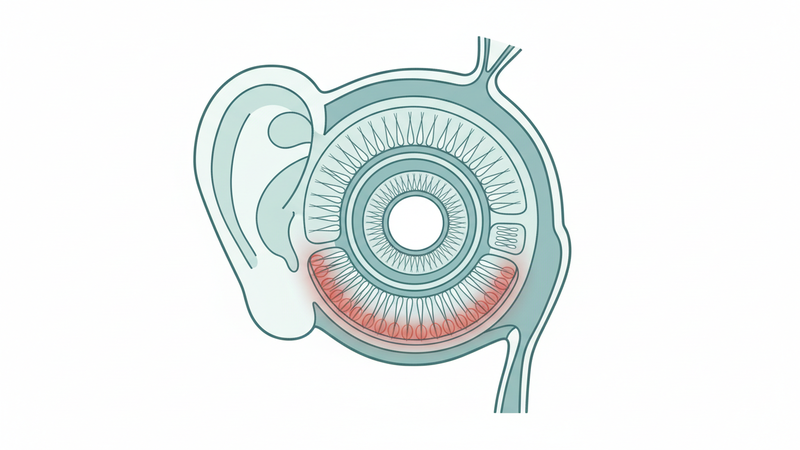
Researchers believed it came down to blood flow — the tiny hair cells inside the cochlea need steady circulation and oxygen to keep functioning normally, and that supply quietly declines with age, noise exposure, and stress.
I sat there staring at the screen, my heart racing.
Reduced blood flow. Irritated hair cells. An auditory system running under strain, all day, every day.
That explained why the ringing never really went away — the underlying strain on the ear was never being addressed, no matter how many earplugs she wore.
But it didn't explain why the nights were so much worse.
That answer came from a second study entirely — one about what tinnitus actually is.
And it was simpler than I ever could have imagined.
You're Not Simply "Noticing It More" at Night. Your Brain Is Generating a Signal With Nothing Left to Compete Against It.

Here is what's really happening — in simple terms.
Tinnitus isn't a sound entering your ear from outside. It's a phantom signal your own auditory system generates internally.
During the day, other noise — traffic, conversation, the television — partially masks it.
At night, in a quiet room, it doesn't have to compete with anything.
That's the real reason almost everyone with tinnitus says it's worse in bed than anywhere else. It isn't getting louder. The competition just disappears.
Meanwhile, underneath that nightly spike, the first problem never stopped: the ear's blood flow and oxygen supply keeps running under strain, from noise exposure, aging blood vessels, and everyday stress.
Two separate mechanisms.
Fix only the first one, and the nights are still unbearable.
Fix only the second one, and the underlying strain on the ear is never addressed — so it keeps getting a little worse, a little more often.
That's the part almost nothing explains — and it's why so many people try one remedy after another and feel like none of it "really" works.
There Are Only Four Ways People Usually Try to Deal With This. Three of Them Only Ever Solve Half the Problem.
Once I understood there were two separate mechanisms, the question became simple.
How do you protect the ear from ongoing strain, and quiet the nighttime signal, at the same time?
There are only four approaches people usually try. Let me save you years of frustration.

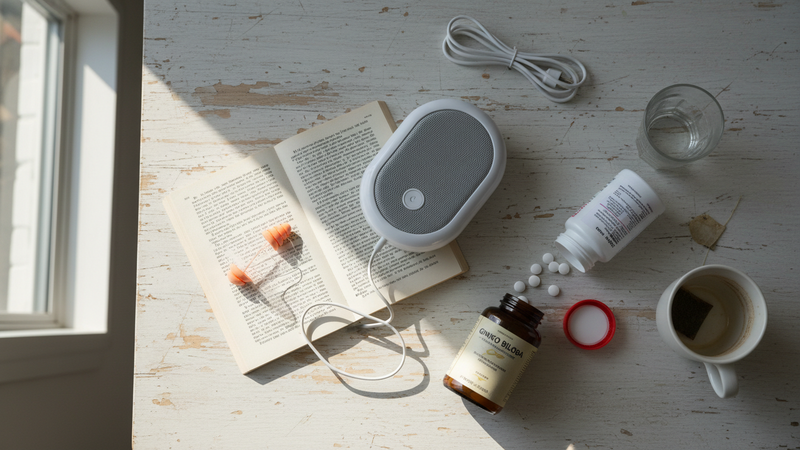
Way #1: Masking Sound
Fans, white noise machines, and sound apps.
They can make a room more bearable for as long as they're running.
But they don't do anything for the strain on the ear itself, and the moment you turn them off, the signal is right back where it was.
You can't mask a problem you're never actually addressing.

Way #2: Common Supplements
Ginkgo biloba. Zinc. B12.
Maybe you've already tried one of these and noticed no real difference.
Of course you didn't.
Most were never studied specifically for the nighttime signal and the underlying ear strain together — usually just one or the other, at doses that don't match what's actually been researched.

Way #3: Prescription Medication
Anti-anxiety medication. Sleep aids. Sometimes antidepressants, prescribed off-label by a doctor.
These are legitimate treatments prescribed by physicians for tinnitus-related distress, and they help many people.
They are not designed to be a substitute for a supplement, and a supplement is not a substitute for them — always follow your doctor's guidance and treatment plan.
 +
+
Way #4: Two Ingredients, Two Different Jobs
Magnesium and melatonin.
Maybe you've already tried one of these on its own and felt nothing.
Of course you didn't.
One ingredient can only do one part of the job.
Magnesium alone can't quiet a nighttime signal and, at the same time, address why the ringing keeps returning. It's only half of the protocol.
But when both are used together, at the right time of day, in amounts inspired by the two studies above?
That combination was what began to change what I was seeing in my mother.
Let me show you why the timing changes everything.
Protect the Ear. Then Quiet the Signal. In That Order.
The protocol has two ingredients.
And each one does a completely different part of the job, at a different time of day.
Skip either one, and the entire thing falls apart.
That's why taking one of them alone rarely produces the results people expect.
Ingredient One: Protect the Ear. Magnesium.
In a placebo-controlled trial, 300 people were followed through two months of repeated loud-noise exposure.
The group given daily oral magnesium had significantly less permanent hearing damage than the placebo group.
Researchers point to magnesium's role in maintaining healthy blood flow and oxygenation inside the inner ear.
Taken consistently, it supports the ear's ability to keep functioning under everyday strain — noise, aging blood vessels, and stress — instead of leaving it to run on less than it needs.
But this addresses the ear itself. It does nothing for the moment you lie down at night and the signal takes over the room.
Ingredient Two: Quiet the Signal. Melatonin.
In a randomized clinical trial, people with chronic tinnitus were split into two groups — one given melatonin, the other given a common prescription used for tinnitus-related distress.
After three months, the melatonin group reported greater improvement on the standard tinnitus severity scale, along with better sleep.
Combined with magnesium in the same daily capsule and taken in the evening, it works with the body's own nighttime rhythm — the exact window when the phantom signal has nothing left to compete with.
Protect. Then Quiet.
That is the idea behind the protocol.
Not one ingredient.
But two, combined in one daily capsule, each studied for a different part of the picture.
But knowing the two functions was the easy part.
Getting the timing and the form right in real life nearly broke me.
Knowing the Protocol Wasn't Enough. It Took Me Almost a Year to Get the Ratio Right.
You may already be thinking exactly what I thought:
"If it's just magnesium and melatonin, I can buy both at the drugstore."
That was the first thing I tried. It didn't work.
Here's what almost no one tells you.
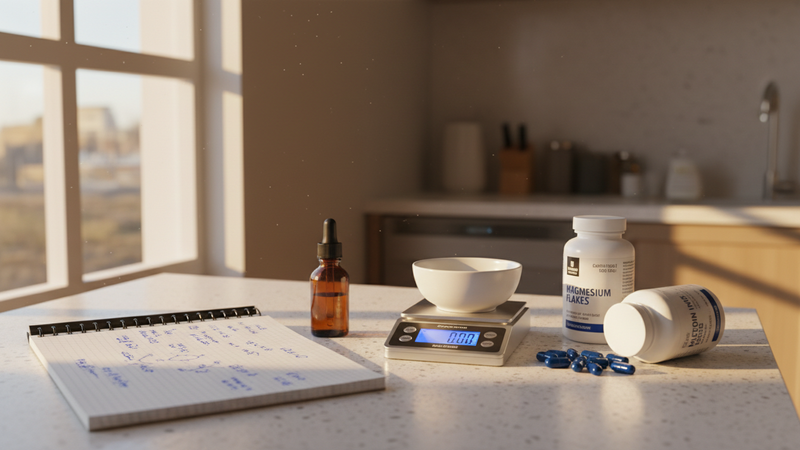
Most Magnesium Supplements Use Forms That Are Poorly Absorbed.
The form matters as much as the dose. Several common forms pass through the body largely unused.
A bottle that says "magnesium" on the label doesn't tell you which form is inside, or how much of it your body can actually use.
Most Drugstore Melatonin Doses Don't Match What Was Studied.
Too little does almost nothing for tinnitus severity specifically.
And taken without the right ratio relative to magnesium, it does very little for the exact window it's meant to help with.
And the Two Have to Be Balanced Against Each Other.
Too much magnesium relative to melatonin, or the other way around, and one blunts the other’s effect.
The form, the dose, and the ratio are the entire protocol.
So I spent almost a year testing combinations — different forms, different doses, different ratios — comparing what my mother noticed against what the research actually said.
Most versions changed nothing.
Until one combination, taken in the evening, is what my mother stayed with.
That was the protocol I finally gave to my mother.
I Watched My Mother Get Her Nights Back. This Is What Changed, in Her Own Words.

I gave my mother that exact combination. The right form, the right dose, in the right ratio.
No new prescription. No sound machine.
Just this.
I want to be careful here, because I'm not going to tell you it disappeared. It didn't, and nothing honest would claim that.
Two weeks in, she mentioned she'd fallen asleep before the fan usually needed to run through the night.
Five weeks in, she told me: "It's still there. It's just not the only thing in the room anymore." Her words, not mine.
She wasn't trying harder to ignore it. The nights had simply stopped being the hardest part of her day.

Eight weeks in, she was reading in bed again.
The kind of small thing that doesn't sound like much, until you remember she'd given it up entirely.
The news spread the way it always does among people living with the same thing.
Her friends wanted to try it. Then their friends did too.
Before long, I was mixing small batches for dozens of people.
That was when I decided to do something about it properly.
So I Made the Real Protocol. The Exact Forms, the Exact Timing. I Called It SilentFlow.

I couldn't keep mixing small batches by hand.
So I took the exact combination I had spent almost a year refining to a specialized lab.
Magnesium, in a form the body can actually absorb.
Melatonin, at the dose used in the research.
Both combined into a single daily capsule, in amounts inspired by the two studies referenced above.
Not a random mix of two separate drugstore bottles.
One capsule. Taken every evening. That's the protocol.
I called it SilentFlow.
I want to be clear about what it is not.
It is not a medication. It is not a miracle cure, and it will not make tinnitus disappear.
And it's not one of the incomplete versions online that only address one half of the mechanism.
It's the complete two-part protocol, dosed the way the actual research was structured.
Protect the ear. Quiet the signal. Both from one capsule, taken every evening.
And I priced it with families like mine in mind, not to maximize margin.
Real People. Nights They Got Back.
My mother was only the beginning.
Here are three more people who used the same protocol.
Results not typical. Individual results may vary.

"I'd run a fan every single night for two years, just to have something else to listen to.
I felt silly buying supplements again after trying so many that did nothing.
But after taking it every evening for about three weeks, I noticed I'd fallen asleep without turning it on.
It's still there. I'm not going to pretend it isn't. It just doesn't run my nights anymore."

"Thirty years around machinery took a toll on my hearing, and the ringing followed.
I'd bought magnesium on its own before and felt nothing, so I almost skipped this too.
Taking them combined, in one capsule, is what made it click for me. My wife noticed before I did — she said I stopped tossing and turning around midnight.
I still notice it during the day. I just don't dread going to bed anymore."

"I used to need background noise constantly, even during the day, just to compete with the ringing.
A few weeks after starting the protocol, my husband pointed out I hadn't asked him to turn the volume up in a while.
I hadn't even noticed. That's when I realized something had actually changed, not just that I'd gotten better at ignoring it."
A gentle note, because I mean this seriously:
Do not take more than the recommended dose because you assume it will work faster.
Getting the timing right is exactly what took almost a year to work out. More does not mean better. Consistency does.
Use it exactly as directed, and give the protocol the time it needs to do the two separate jobs it was designed for.
Today, You Can Get SilentFlow for Just $19.99

Let's talk about what this should cost.
Sound machines, drugstore supplements, and other things people try along the way can add up over time — for many people, hundreds of dollars, if not more.
Given the ingredients and the research behind them, a kit like this could easily be priced at $100.
But I didn't build this to maximize margin. I built it for my mother.
And for people like you, who shouldn't have to choose between a quiet room and paying the bills.
That's why I'm making SilentFlow available today at the special launch price of just $19.99 per kit.
That's 80% off the $100 estimated value.
When you order 3 kits of SilentFlow today, you'll receive 3 additional kits completely free.
Today's Special Launch Offer
BUY 3 KITS AND GET 3 MORE FREE
80% OFFJust $19.99 per kit
6 bottles of the combined formula — one capsule, used daily as directed.
This launch pricing is available for a limited time and may change without notice.
SilentFlow is a dietary supplement and is not intended to diagnose, treat, cure, or prevent any disease. It is not a substitute for medical advice, diagnosis, or treatment. Tinnitus has many possible causes — consult your doctor before starting any new supplement, especially if the ringing is sudden, one-sided, or accompanied by hearing loss, dizziness, or pain. Individual results may vary.
60-Day Money-Back Guarantee
Use the Full 60 Days. If Your Nights Don't Change, I'll Refund Every Penny.

I know you've already spent money on things that failed to deliver what they promised.
That's why I'm taking on the risk.
Try SilentFlow for 60 days. Use it exactly as directed, one capsule every evening.
If your nights don't change...
If the ringing still takes over the moment the room goes quiet...
Or if you simply don't feel like anything is different...
Send a message to my team, and we will refund every penny.
Empty bottles. No interrogation. No arguments.
Either you keep the results, or you keep your money.
This is not just a marketing line.
It's a promise from the person who put this protocol together.
SilentFlow 60-Day Guarantee
Use the full protocol, one capsule every evening, for 60 days.
If you don't notice a difference in how your nights feel, simply contact us.
We will refund every penny.
No return-window tricks. No fine print.
Your only risk is doing nothing while the nights stay exactly the same.
See How to Get Started Tonight

It's simple.
1. Tap the button below and choose your kit.
Most people start with three or six bottles — partly to save money, and partly because once your nights start changing, you won't want to risk interrupting the protocol.
2. Enter your information on the secure checkout page.
3. Your SilentFlow kit ships directly to your home.
Starting tonight: one capsule, taken as directed.
Then go on with your day as usual, and let the protocol do the two jobs it was designed for:
protect the ear from ongoing strain, and quiet the signal when the room goes silent.
Six Months From Now, Either Your Nights Are Different, or You're Still Reading Articles Like This One

Here's the truth no one likes to say:
This doesn't get better on its own.
Another year of the fan running all night. Another year of dreading the moment the room goes quiet.
The saddest thing I hear from people is always the same:
"I wish I'd started sooner."
That doesn't have to be you. Not tonight.
Imagine lying down and the ringing not being the only thing in the room.
Falling asleep without needing something else to compete with it.
This isn't about the ringing disappearing.
It's about the nights not belonging to it anymore.
SilentFlow was built to help with exactly that — the exact forms, the exact timing, developed by the person who put the protocol together, not someone who copied half of it.
Diane is an independent health researcher. SilentFlow is a dietary supplement and is not intended to diagnose, treat, cure, or prevent any disease. Tinnitus has many possible causes — consult your doctor, especially if the ringing is sudden, one-sided, or accompanied by hearing loss, dizziness, or pain. Individual results may vary.
Ingredients & Scientific References
What's Inside
Magnesium — studied for its role in maintaining inner-ear blood flow and oxygenation, and for reducing permanent noise-induced hearing damage in a controlled human trial.
Melatonin — combined with magnesium in the same evening capsule, studied in a randomized clinical trial for reducing tinnitus severity and improving sleep in people with chronic tinnitus.
References
- Attias J, Weisz G, Almog S, et al. Oral magnesium intake reduces permanent hearing loss induced by noise exposure. Am J Otolaryngol. 1994;15(1):26–32. PubMed 8135325
- Hoseinabadi R, et al. Comparison of Melatonin and Sertraline Therapies on Tinnitus: A Randomized Clinical Trial. Int J Prev Med. 2017;8:61. PubMed 28966750
Refers to independent research on these ingredients in general, not clinical testing of SilentFlow® as a finished product. These statements have not been evaluated by the Food and Drug Administration.